
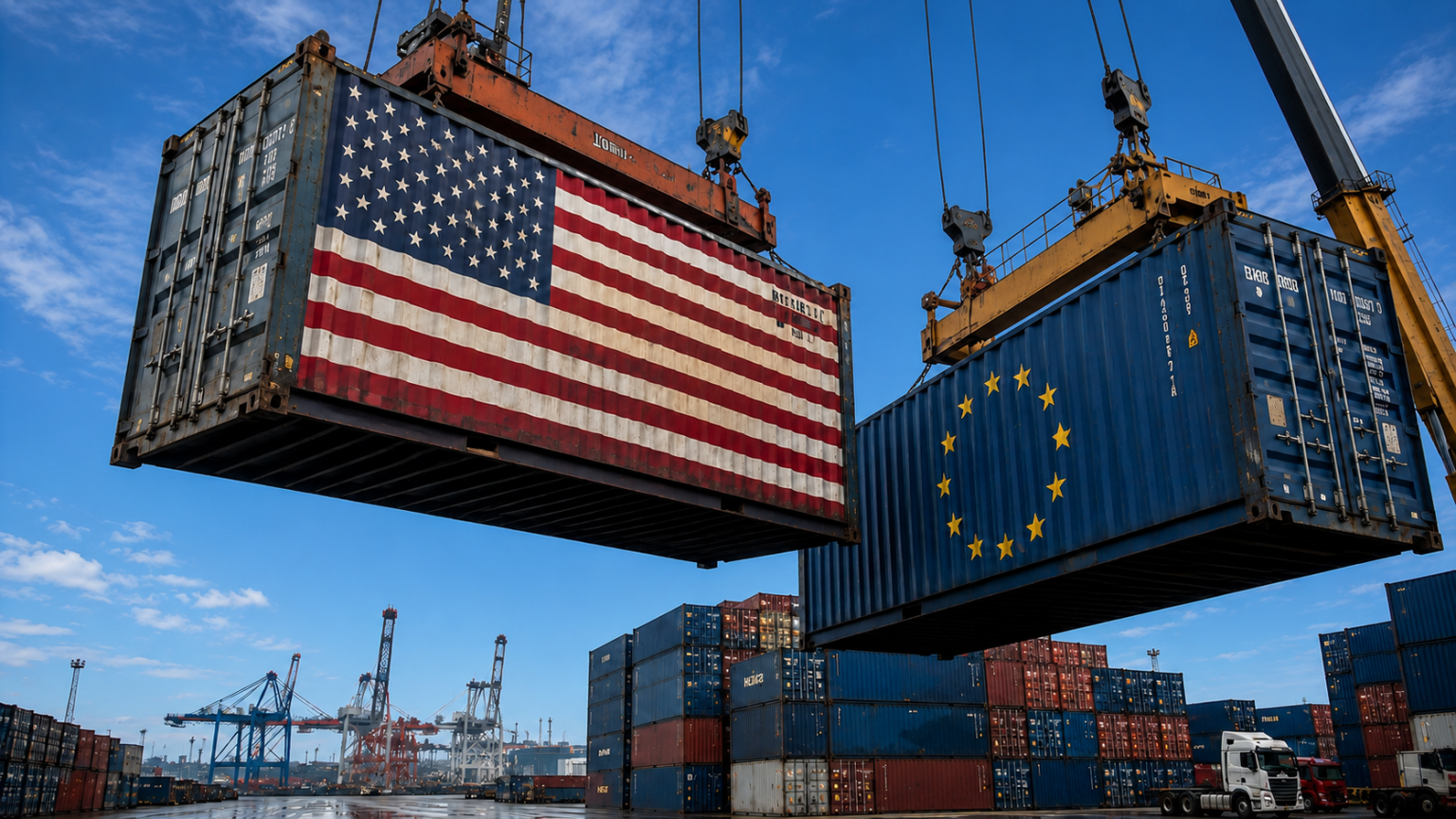
This article outlines what the regulation establishes, which goods are covered, and what documentation is required to correctly apply the exemption at customs clearance.
What Is Regulation (EU) 2026/1455?
Regulation (EU) 2026/1455, published on 30 June 2026 and in force since 1 July 2026, adjusts the customs duties applicable to imports of goods originating in the United States and opens new tariff-rate quotas.
It implements, on the tariff side, the trade framework agreed between the European Union and the United States.
How Is the Duty Reduction Structured?
The regulation does not apply a blanket 0% rate to every product. Instead, coverage is divided across three annexes.
Annex I: 0% Import Duty
A broad list of chapters and product codes under the Common Customs Tariff now carry a 0% import duty.
Annex II: Removal of the Ad Valorem Component
For another group of products, the ad valorem component of the duty — the part calculated as a percentage of the goods’ value — is removed.
However, a specific duty component may still apply in certain cases.
Annex III: 0% Tariff-Rate Quotas
Certain agricultural and processed agricultural products benefit from tariff-rate quotas at a 0% rate, applicable up to the volume established for each twelve-month period.
What Does This Mean in Practice?
In general terms, many US-origin goods no longer pay import duty when released for free circulation in the European Union.
VAT continues to apply as usual, as the exemption affects customs duty only.
Coverage varies depending on the product’s tariff classification. Eligibility should therefore be confirmed for each specific item before assuming that a 0% rate applies.
Key Requirement: Proving the Origin of the Goods
The exemption does not apply automatically. Importers must be able to prove that the goods are of US origin.
Article 59a of Implementing Regulation (EU) 2015/2447, introduced by Implementing Regulation (EU) 2026/1422, does not establish a standardised proof-of-origin document, unlike other preferential trade regimes.
Instead, the free-evidence principle applicable to non-preferential origin applies. The origin of the goods must be reflected on the commercial invoice or accompanying shipment documentation in a way that Customs can verify.
As this regulation has only recently entered into application, practical documentation requirements at customs clearance may continue to be refined.
We recommend confirming the exact documentation required with a customs agent before each import operation.
Frequently Asked Questions
When did the elimination of duties on US goods take effect?
The new measures took effect on 1 July 2026 under Regulation (EU) 2026/1455.
Are all US-origin goods duty-free?
No. Coverage depends on the product’s tariff classification and whether it is included in Annex I, Annex II or Annex III. Eligibility should be checked on a case-by-case basis.
Does VAT still apply to these imports?
Yes. The change affects customs duty only. Import VAT continues to apply as usual.
What document proves the US origin of the goods?
There is no mandatory standard certificate of origin specifically established for this measure. Origin must be reflected on the commercial invoice or other supporting documentation that allows Customs to verify it, under the free-evidence principle applicable to non-preferential origin.
Until when will the duty exemption for US-origin goods apply?
The duty exemptions are scheduled to apply until 31 December 2029. However, they may be suspended before that date if the conditions of the EU–US trade framework are no longer fulfilled.
Questions About a Specific Import?
Our Customs team can confirm whether a product qualifies for this exemption and advise you on the documentation required at customs clearance.
Contact us at customs@evolutionagents.com
